A major controversy has emerged in the New Orleans community after a beloved icon of the New Orleans Saints found himself at the center of an unexpected disciplinary decision.
The incident took place at a local high school, where Drew Brees had been serving as a volunteer coach, working closely with student athletes in the football program.
What began as a heartfelt effort to give back to the community has now evolved into a broader debate about rules, fairness, and the boundaries of support in amateur athletics.
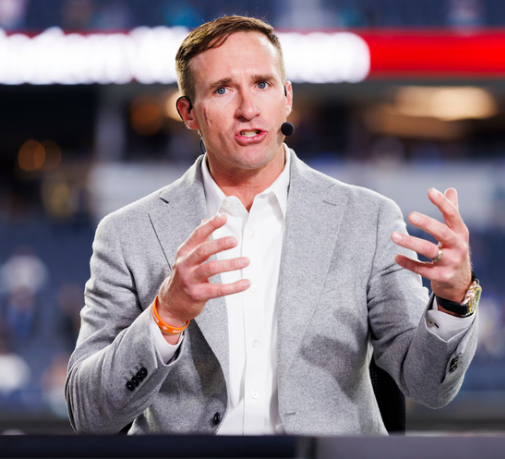
According to multiple reports, Brees used his own financial resources to assist players facing difficult personal and economic circumstances.
Among those efforts were covering transportation costs for students traveling from unsafe neighborhoods or long distances, ensuring they could attend practices consistently and safely.
He also introduced professional level recovery resources, including access to physical therapy and advanced training equipment rarely seen at the high school level.
In addition, Brees reportedly funded high quality pregame meals, replacing limited school provided options to help players compete at their best physically.
While many viewed these actions as extensions of Brees’ long standing reputation for leadership and philanthropy, governing officials saw the situation differently.
The Louisiana High School Athletic Association ruled that these benefits violated amateur competition guidelines, citing concerns about creating an uneven playing field.
As a result, Brees has been suspended from all coaching activities and barred from the sidelines for the remainder of the season.
The decision has triggered strong reactions across the New Orleans area and beyond.
Supporters argue that Brees’ actions were rooted in compassion and a genuine desire to uplift young athletes, not to gain any competitive advantage.
They point to the realities many student athletes face, including financial hardship and lack of access to basic resources, as justification for his involvement.
Critics of the ruling believe it highlights a disconnect between rigid regulations and real world challenges within local communities.
Others, however, maintain that rules must be applied consistently to preserve fairness across all programs, regardless of intent.
The debate has quickly spread throughout the broader football community, with current and former players weighing in on both sides.
For many, the situation raises a larger question about where the line should be drawn between support and competitive influence.
Brees has not publicly criticized the decision but is said to be disappointed by the outcome.
Despite the suspension, those close to the program believe his impact on the players will remain lasting.
For now, he remains sidelined, but the conversation surrounding his actions continues to grow.
In New Orleans, the legacy of Drew Brees has always been about more than football.
And in this case, the discussion he has sparked may prove just as significant as anything he accomplished on the field.